


Les 5 erreurs coûteuses à éviter lors du choix des portes et fenêtres au Québec
- Mar 10
- 4 min read
Updated: Apr 7
Que ce soit pour une rénovation ou une nouvelle maison, les 5 erreurs coûteuses à éviter lors du choix des portes et fenêtres au Québec auront un impact direct sur la performance énergétique, le confort et la durabilité d'un bâtiment.
Dans le climat québécois, caractérisé par des hivers rigoureux, des vents forts et des variations de température significatives, la qualité du système choisi devient essentielle.
Cependant, de nombreuses décisions sont encore prises sur la base de critères incomplets ou mal compris. Par conséquent, certaines fenêtres doivent être remplacées bien plus tôt que prévu.
Remplacer des fenêtres représente souvent un projet beaucoup plus important qu'on ne l'imagine.
Une correction peut nécessiter :
le retrait complet des fenêtres existantes
l'installation d'une nouvelle unité
la ré-isolation de l'ouverture
le retravail des finitions intérieures et extérieures
Ces travaux peuvent rapidement représenter des coûts bien plus élevés que les économies réalisées sur l'achat initial.
C'est pourquoi il est préférable de choisir vos fenêtres avec soin dès le départ et de bien faire les choses la première fois.
Voici les 5 erreurs les plus courantes lors du choix ou du remplacement des portes et fenêtres au Québec.
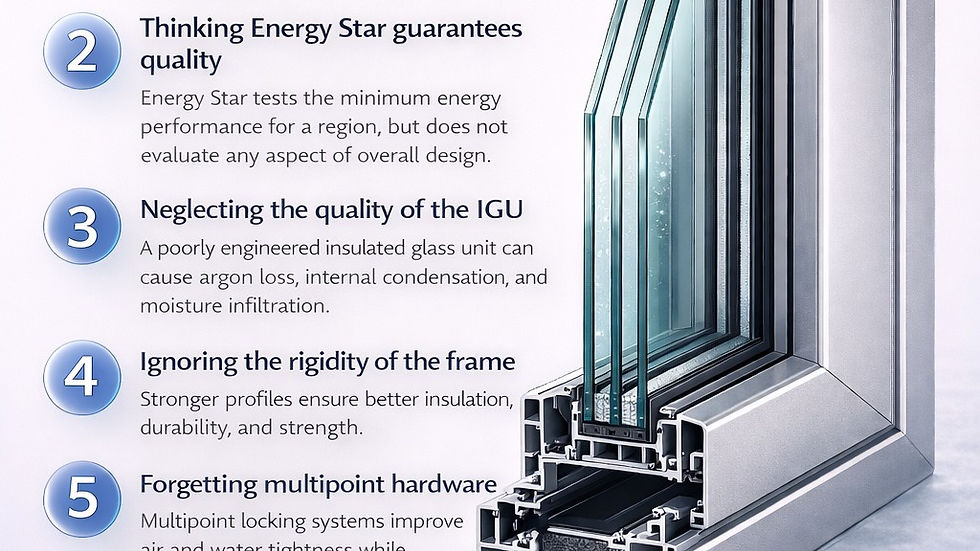
Résumé
Comparer uniquement le prix
Confondre la certification ÉnerGuide avec la qualité globale du produit
Négliger la qualité des unités vitrées (thermos)
Sous-estimer l'importance du profil de fenêtre
Négliger le matériel et le système de verrouillage
1. Comparer uniquement le prix
Lorsque commence un projet de remplacement de fenêtres ou de nouvelle construction, le prix est souvent le premier critère analysé.
Cependant, le prix d'achat ne reflète pas nécessairement la performance réelle d'une fenêtre.
Les produits à bas prix peuvent inclure :
des profils moins rigides
un matériel simplifié
des unités de verre de qualité inférieure
une précision d'assemblage limitée.
Dans un climat comme celui du Québec, ces facteurs peuvent rapidement affecter :
l'étanchéité
la performance énergétique
la durabilité du système.
Un produit moins efficace peut donc entraîner des coûts de remplacement beaucoup plus élevés à moyen terme.
2. Confondre la certification ÉnerGuide avec la qualité globale du produit
La certification ÉnerGuide indique qu'une fenêtre répond à un niveau minimum de performance énergétique établi pour une zone climatique donnée.
Le Québec se situe dans une zone climatique froide, où les exigences en matière de perte de chaleur sont plus élevées.
Au Canada, les fenêtres doivent également répondre aux exigences de la NAFS/CSA A440 (Norme nord-américaine de fenestration), qui établit des critères de performance pour les portes et fenêtres, y compris :
l'étanchéité à l'air
la résistance à l'eau
la résistance au vent
la performance structurelle.
Cependant, la certification ÉnerGuide se concentre principalement sur la performance énergétique.
Elle ne garantit pas :
la durabilité structurelle
la qualité de l'installation
la performance acoustique
la sécurité
la résistance au vent à long terme.
En d'autres termes, une fenêtre peut être certifiée ÉnerGuide et respecter la norme NAFS/CSA A440, tout en présentant des différences significatives en matière de conception, de rigidité du profil, de qualité du matériel ou de fabrication des unités vitrées.
La certification constitue donc un indicateur énergétique, mais elle ne remplace pas une analyse complète de la conception et de la qualité du système.
3. Négliger la qualité des unités vitrées (thermos)
Le vitrage représente généralement 70 à 80 % de la surface d'une fenêtre. Par conséquent, la qualité de l'unité de vitrage influence directement la performance globale.
Plusieurs éléments techniques sont cruciaux :
la présence de gaz argon entre les vitres
l'utilisation d'un intercalaire isolé (bords chauds)
la qualité du joint du thermos
le processus de fabrication de l'unité de vitrage.
Une unité de verre de mauvaise qualité peut entraîner :
une perte progressive de gaz argon
des infiltrations d'humidité
l'apparition de condensation entre les vitres
un désembuage prématuré du thermos.
La qualité du joint et du processus d'assemblage est essentielle pour garantir la performance et la durabilité à long terme.
4. Sous-estimer l'importance du profil de fenêtre
Le profil forme la structure de la fenêtre.
Son design influence directement :
la rigidité du cadre
la stabilité dimensionnelle
la performance thermique
la résistance aux charges de vent.
Des profils plus avancés incluent généralement :
plusieurs chambres d'isolation
une meilleure gestion des ponts thermiques
une rigidité structurelle supérieure
une précision d'assemblage améliorée.
Ces caractéristiques deviennent particulièrement importantes dans un climat nordique comme celui du Québec.
5. Négliger le matériel et le système de verrouillage
Le matériel joue un rôle crucial dans la performance globale d'une fenêtre.
Les systèmes de haute performance utilisent des mécanismes de verrouillage à plusieurs points, qui permettent :
une compression uniforme sur les joints
une meilleure étanchéité à l'air
une résistance accrue à l'infiltration d'eau
une sécurité renforcée.
Un matériel simplifié peut entraîner une perte d'étanchéité au fil du temps et réduire la durabilité du système.
Conclusion : Choisissez vos fenêtres avec soin dès le départ.
Que ce soit pour une nouvelle construction ou un projet de rénovation, la performance réelle d'une porte ou d'une fenêtre dépend de plusieurs éléments techniques :
la qualité des unités vitrées
la présence d'argon et d'intercalaires isolés
la rigidité des profils
la qualité du matériel
la précision d'assemblage
la qualité de l'installation.
Une certification énergétique est un indicateur utile, mais la conception globale du système et la qualité de fabrication restent les facteurs déterminants pour garantir la durabilité dans les conditions climatiques du Québec.
Vous envisagez de remplacer vos fenêtres ou de construire une maison ?
Chez VST, nous privilégions des systèmes de portes et fenêtres conçus selon des normes d'ingénierie avancées, reconnus pour leur performance thermique, leur robustesse et leur durabilité dans les climats nordiques. Contactez notre équipe pour discuter de votre projet et découvrir des solutions performantes adaptées au marché québécois.


